 | THE USA |
THE LOST COLONISTS
If you know your 16th Century history at all, you will know that Roanoke Island plays a vital role in American history, for it was the site of the first colony of English settlers in North America. And they settled more-or-less on this spot. And that was quite by accident too.
For an Elizabethan sailor, Roanoke Island has a great deal going for it. If you can arrive here in daylight (so that you don't run aground on the Outer Banks in the dark as so many of the visitors seem to have done over the passage of time) and then negotiate the channels between them, then here is a nice, calm, temperate island protected from the winds and the storms. With enough people, an island can be easily defended and you can always sally forth to the mainland to capture whatever it is that you don't have enough of. Always assuming, of course, that you haven't made friends with the original inhabitants in the first place.
HISTORY
When the first English explorers came to this area in the summer of 1584, they found a pleasant and verdant landscape, abundant wildlife and generous natives. Thus, having claimed the land for Good Queen Bess and Sir Walter Raleigh, on whose behalf the expedition had sailed, they sailed back to England with glowing reports.
Raleigh, having been suitable impressed, sent a party of 108 colonists under the command of Sir Richard Grenville to establish themselves on the island. Stopping en route to generally loot and pillage a few Spaniards on the way (much to the annoyance of those latter), they eventually arrived here at the end of June 1585, having completely missed the spring planting season. Then just to make sure that they would be absolutely certain to see the spectre of starvation, they then proceeded to estrange the natives by burning one of their villages. All of this is having a remarkably familiar ring to it, is it not?
After a short while, Grenville returned home (stopping en route to capture a Spanish trading vessel) leaving Ralph Lane in charge of the colony. Lane's first action, rather wisely as it turns out, was to build a fort for protection.
As supplies of food began to dwindle, and the natives' initial arms-length friendliness gradually melted away, relations became strained between the colonists and the natives, as well as among the colonists themselves. They split into smaller parties, each going their separate ways - one group even resorting to living on shellfish and flagging down passing ships.
The crops of the following year, 1586, (such as were sown by the colonists) were enough to make them realise that maybe the initial reports of the first party may have been somewhat overenthusiastic, or that 1584 was simply an exceptional year for agricultural produce. Simmering discontent between the colonists and the natives erupted into open warfare, and when a passing Sir Francis Drake offered the colonists the opportunity to return to England, not very many were disappointed to leave.
Shortly afterwards, a supply ship sent by Raleigh arrived. Finding the colonists gone, the ship returned to England. Two weeks later, Grenville arrived. His response upon finding the colony abandoned was to fit out an expedition of 15 men with supplies for two years and leave them to hold the fort - the fort that Lane had built.
The next year saw Raleigh assemble a group of 150 colonists, this time including women and children, to establish a colony further north in the Jamestown - Chesapeake area. After much sailing about the Caribbean, the expedition stopped at Roanoke to check on the garrison left behind the previous year. All they found were the bones of one soldier.
By now it was the end of July. This is late in the year and the storm season is just around the corner. The sailors, despite several weeks of debate and discussion, were determined not to stay or to continue their mission to ferry the colonists to Chesapeake Bay.
The colonists had not been idle during this couple of weeks. Having already lost one of their number to the natives and having suffered other irritations, they determined to wipe out those living in a nearby village. The natives, having learned of the plans, fled the village. The colonists found themselves attacking, and killing, a group of more-friendly Croatoans who had simply called by to loot whatever the Roanoke indians had abandoned. This did not, or course, go down well with the Croatoans, as one can easily imagine. As I said, all these stories have a remarkably familiar ring to them.
Two children meantime were born to the colonists. The first, Virginia Dare, was born on 18 August 1587. She is said to be the first white child born in North America (although I remain unconvinced - see below) and the second, whose given name is not known, was born to the Harvie family.
On the 27th August, the fleet set sail for England, more-or-less abandoning the colonists at Roanoke Island to their fate. With it sailed the last definitive news of the colony and its colonists. Amongst those returning was the person nominated as the colony's governor, John White. His self-proclaimed mission was to "seek further supplies". Cold feet? Perish the thought.
By this time, war with Spain had broken out in earnest and this is the period of the Spanish Armada. The war spread over to the Americas and it is well-documented that in 1588 at least one Spanish expedition reconnoitred the bay. Their conclusion was however that the settlement and harbour were too weak to bother with destroying.
Due to all kinds of circumstances, an English relief expedition did not sail for Roanoke Island until 1590. When it finally arrived, in late August, it found the colony abandonded, evidently for some time. All of the colonists' houses had been dismantled however, and the area had been strongly fortified with palisades, as if the colonists had abandoned any attempt at village life and adopted a seige mentality within its walls.
They found a message - CROATOAN - carved on one of the posts. As this was not accompanied by the agreed distress signal it was generally agreed that the colonists had voluntarily abandoned the fort and the colony to settle amongst the Croatoan indians on Croatoan Island. Any idea of going to the island to check was dispelled by a storm that blew the ships out to sea, and they fled back to England.
It was not until 1602 that another attempt was made to locate any survivors. Although this expedition visited Croatoan Island, no trace of the colonists was ever discovered and the captain himself was to admit that fears about the weather had preoccupied him more than his search for any colonists. According to the museum, the colonists simply vanished into the mists of history.
THEORIES
Research reveals that there are several theories concerning their possible fate. There were claims by later explorers that there were white-skinned members of several tribes of indians in the area, some of whom were even able to read. This leads many people to consider that the colonists may have been assimilated into the native population. But this begs the question as to why those white-skinned members never came forward to identify themselves. What could probably be the answer to this conundrum would be that seeing as this is a major sea lane, even in the early 17th century, many ships could have wintered here with the crews making free amongst the womenfolk in order to pass the time. These white-skinned members of so many tribes could well be the offspring of such unions.
Others suggest that the party may have tried to make for Chesapeake Bay, the site originally chosen for the settlement. That is quite some voyage in an open boat and it would be no surprise if a catastrophe were to occur en route leaving no survivors to tell the tale. How 150 colonists, give-or-take a few here and there, would have fitted into an open boat is something that weighs heavily against this otherwise-plausible theory. It is unlikely that the colonists would have had the skills or the material to throw together something large enough and strong enough that might have stood a chance of braving the open seas in the direction of Chesapeake Bay with all of them on board.
The Wright Brothers had their own theory as to what happened to the lost colonists. Having suffered for a couple of years at Kill Devil Hills just a couple of miles to the north of here, they claimed that they "were eaten by bloody mosquitoes".
My theory though is much less romantic than any of the others. I consider it possible that the surviving colonists, having effectively given up the idea of a colony to live the rest of their lives walled in and under seige, would have seen the arrival of a heavily-armed ship loaded with white men with some air of optimism and relief - even if it was a Spanish ship belonging to your country's current enemy. No-one can ever know the fear that must have run through the minds of the colonists that had made them abandon their village to live under seige like they did.
"Better the devil you know than the devil you don't know" must surely have run through the minds of the colonists. They may well have accepted an offer of evacuation and a ride back to Europe, even if they had the idea in the backs of their minds that such a ride may actually take them into slavery in some remote Spanish colony and an inevitable early death from disease or overwork. This was a risk they would have to take, but at least it would be among fellow Christian souls rather than a lonely and probably cruel death amongst heathen savages. This is, of course, always assuming that once on board the ship, it did not sink with all hands on the way - not a rare hazard in the waters all around here as the Outer Banks will testify.
It is inconceivable that the Spanish party that visited here in 1588, seeing how weak the colony was, did not venture ashore to take the opportunity to seize the colony and everyone in it for the Spanish crown. The vague and nebulous report prepared by the Spanish commander is evidently deliberately vague and nebulous, and one wonders why it was not written with more forthrightness. It certainly asks more questions than it answers, and it certainly makes one wonder what it was that the commander was trying to hide. Its desired effect, that of assuring that no-one else would take the trouble to go to visit the colony, was certainly accomplished. But why go to all of this effort to justify why he didn't go to explore, and why no-one else should waste their time either. It all sounds fishy to me.
OUTSIDE

So having visited the visitor centre and seen the exhibition, the next step was to go round to the back (the rain having eased off slightly by now) and follow the trail around the site.
First exhibit you encounter is a stone tablet announcing that somewhere"near this site" on 18 August 1587 was born Virginia Dare, the first white child to be born in North America but see below, as I said earlier. It doesn't say how near to this site she was born. It may just as well be sited anywhere.
In fact, nowhere - whether inside the exhibition hall or out here on site - was there any information about how accurately this site was measured out. There is merely a notice to the effect that "archaeologists succeeded in uncovering no trace of any colonists' buildings" (now that is what I call an enigmatic statement).

In the background of the photo above you can see Lane's fort. Here on the left is a better view. Again, there's no indication as to whether any of this is original, or that it's even in the correct place.
There are certainly reports that even as late as the 1890s there were remains of the fort that could be clearly identified, and just after World War II excavations here revealed traces of a fortification. One hopes that this replica bears some resemblance to the original.
It seems that the manner of construction was to dig a deep ditch (presumably lining the bottom with sharpened sticks) and throw the soil inwards to make some kind of breastworks. Then the breastworks would be lined with vertical logs to make a high, solid wall. The floor plan would be the typical "star" effect to ensure that anyone tryng to climb the wall from the outside could be fired upon from another vantage point within the fort. Anyone who has seen the ultimate development of a layout such as this, in one of the "Vauban" fortresses of North-Eastern France will know just how effective this design can be.

A look at the inside of the fort gives you some idea of how large it is, and hence how much effort was put into its actual construction by the colonists. It's much too large for a party of 15 men. How on earth would they have been able to have manned all of the wall during an attack by a determined horde of natives?
What is interesting to note though is that the fort is situated with such an excellent view through the trees over the water and out to sea, which is slightly to the left of the view of this photo. The reason why I find this so interesting is because it seems to indicate that the colonists were less afraid of an overland attack (by the native Americans?) and more afraid of a seaborne attack (by the Spaniards?). This in itself speaks volumes.
But the fact remains that regardless of all of the precautions taken by the inhabitants, some catastrophe happened that overwhelmed them all.
What surprises me is that the subsequent settlers of this area did not carry out a search for any graves of colonists who had died in the period between the establishment of the colony and its desertion. We know that there were several deaths amongst the colonists, and it would have been interesting to see what the bodies could say. It was, after all, by the tracing and examination of the bodies of the victims that the tragic Franklin expedition was tracked to its final and grisly conclusion in the frozen north of the continent.
From the fort, there is a system of nature trails around the site, with notices explaining the various fauna and flora that can be found around here.
It was quite interesting to read the notices concerning what was grown here by the native Americans, and how much of our own 21st Century culinary habits were influenced by the discoveries that were made by the early explorers who came into contact with native North American cuisine.
"THE LOST COLONISTS"
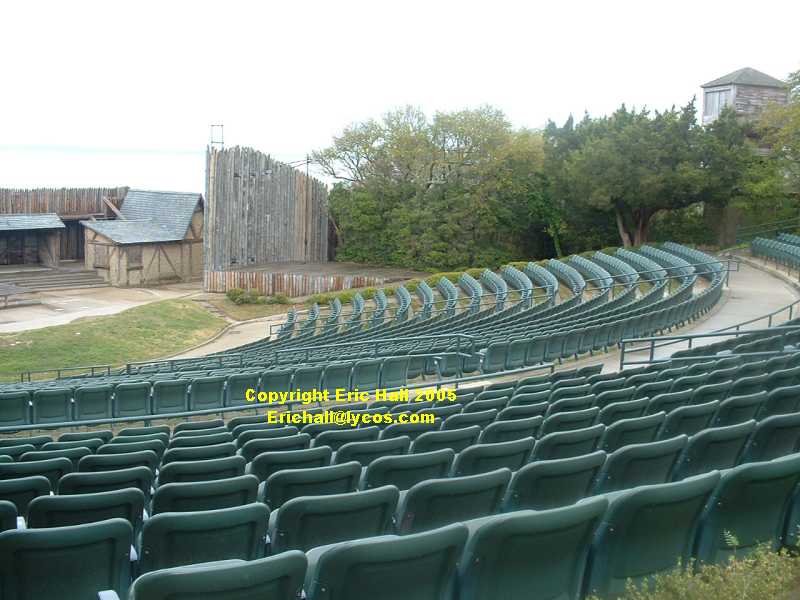
Further on from here is an open-air theatre with a magnificent view across the Sound. Apparently every evening there is a production of a play entitled "The Lost Colony". It is a theatrical presentation of someone's interpretation of the events that led to the history and subsequent disappearance of the colonists in the 1590s. The play has been running probably as long as "The Mousetrap" and during all this time it hasn't been without its problems. The theatre has burnt down and has also been blown away in a hurricane. The cynic in me wonders if this may not be why it's now performed in the open air.
One of the actresses played the same role for 27 years. Now, how sad is that? At least when you're in a soap opera you're allowed to age along with the plot and the rest of the cast. How could anyone play the role of, say, a young woman for 27 years? It beggars belief.

But there's no getting away from the fact that the setting here is truly superb. This view alone would be well worth the price of the admission. It reminds me very much of one of these classical Greek theatrical settings, the type to which people would have flocked 2500 years ago to see something like "Agamemnon" by Aeschylus, or Sophocles' "Elektra".
The fact that the same actress played the same role for 27 years indicates that the play is symboic rather than dramatic, and probably fulfils a similar social function to that of the Greek tragedies above. The act of coming to see it is probably similar to the reason why people flock to see "The Mousetrap" when surely everyone knows the story and the plot by now - just to say that "I was there".
Now that I've finished my tour of the site, I can make some comment on my thoughts. From my own personal point of view, what was disappointing about the exhibition and the visitor centre was that there wasn't anything like enough information of the excavations of the site, the archaeological evidence and the hunt for any survivors. The whole question about the site from the time of the 1590 expedition until the current day seemed to be just left up in the air. If there was nothing to report, then one would have expected them to state this. My own research indicates however that there is a great deal further to say, as you can see from the above.
FURTHER THEORIES
As I said earlier, I'm not convinced that Virginia Dale was the first white child to be born in North America. For a start, there's indisputible evidence of a Viking presence at L'Anse aux Meadows in Newfoundland, and many people suggest that this might be the Vinland of the Norse sagas. A variety of domestic artefacts suggesting some kind of permanent settlement, involving both sexes, at the site has been discovered during archaeological investigations there and it is reasonable to suppose, given the nature of some of these artefacts, that there was some kind of domestic life here.
The original Norse sagas of the period describe how several parties of Norse settled in Vinland, and there is no reason to disbelieve their accounts in the main. One group, led by Thorfinn Karlsefni, and counting 135 men and 15 women, settled in Vinland and stayed for several years. The sagas go on to claim that at least one child, named Snorri Karlsefnisson, was born in Vinland. This was long before it became any kind of issue to make a claim to be the first European born in North America.
The problem was that the Sagas weren't actually translated from the Norse until the 1840s, by which time the story of Virginia Dare was already firmly planted in the minds and in the folklore and history of North America and the Americans. No-one is, of course, going to give up on their legend and their history and award a title to someone else that they have been claiming for themselves. The sagas were merely dismissed as pure speculation and nothing more than exciting works of fiction until 1960, when Helge Ingstad and Anne Stine, following a suggestion by William A Munn in his book "Wineland Voyages: Location of Helluland, Markland, and Vinland" discovered vestiges of a Viking settlement at L'Anse aux Meadows. And if the contemporary sagas have been proved right in as much of the factual detail as is possible to prove, then there would seem to be no particular reason to doubt the rest of the story.
Some people, having read my notes above, argued that Newfoundland is a mere outlying island and not part of North America per se. However, Charles Lindbergh is always claimed as being the first person to make a successful solo flight across the Atlantic from New York to Paris. However, he didn't actually depart from the mainland of the USA but from Long Island, which is an ... errr ... island off the coast of the USA. Nevertheless, it still doesn't prevent people from promoting his claim, neither did it prevent Raymond Orteig giving him the $25,000 prize. It has to be remembered that Newfoundland is only a small step away from the North American mainland.
The argument raged from there, and I really was told that you can't actually see the Labrador coast from Newfoundland. With a challenge like that, well, there's only one thing to and I had to wait until 2010 when the Canadian Government finished building a road to the Labrador coast. And the result? Well, see for yourself
.
From there it was only a short (insofar as any distance is short in the wilderness of the outback of Canada) drive to Newfoundland and I made it to L'Anse Aux Meadows
. Having had a good poke around the site, then in my opinion, two factors would seen to support the theory that the Vikings did progress on from here to the North American mainland.
Firstly there is evidence of a considerable ship repair facility at L'Anse aux Meadows. The presence of an ironworks complete with metalworkers would seem to indicate that this can't be just some itinerant or casual arrangement to fix up some boat damaged on the crossing, but a more serious adventure to overhaul a fair number of boats before they sailed back across the open water to Greenland. Assuming this to be the case, where would they all have been and how long would they have been there to deteriorate in such a fashion as to need such an overhaul?
Secondly excavations at the site have found evidence of plants and products not found on Newfoundland but on mainland North America. It's true to say that the climate was quite different 1000 years ago and the planet has cooled considerably since. Crop lines have generally retreated towards the equator since then (vines were cultivated in the Midlands of England in earlier times) and are only slowly creeping back, but what makes this significant in Newfoundland was that it is an island so there is no place for the crops to retreat to, and there has been no evidence uncovered of any local growth of such products.
While I'm unconvinced that L'Anse aux Meadows is the Vinland of the Norse sagas, it is without any serious question a Viking settlement, almost certainly in my opinion an unrecorded one. The absence of any written record doesn't prove a thing, particularly amongst a people who for the most part were unable to write. My opinion is that its purpose could well have been a settlement fulfilling the functions of a central trading point from which boats would set out to explore the mainland for the purpose of collecting articles and objects to improve the quality of life of the setlers on Greenland. My suggestion is that these boats would depart for the mainland in spring and return to l'Anse aux Meadows in Autumn to transship their cargoes onto larger boats which would then sail to Greenland. The traders would shelter here throughout the North American winter (don't forget that winters were milder 1000 years ago than they are now) and repair their boats and carry out other tasks, such as dressing tree trunks for use as lumber back in Greenland.
It is surely no coincidence at all that 700 years later the French had a settlement at Louisbourg fulfilling exactly the same function and only a few days' sailing further south on Cape Breton Island, and the British had a similar settlement just another day's sailing further south at Halifax
. There is also undisputed evidence that Greenlanders were still sailing to Labrador for timber as late as 1347.
Furthermore, there are many tales in many branches of native American history along the North-Eastern coast of North America of a "savage tribe of pale Indians" moving southwards down the coast. These tales all seem to date from the same period - at the start of the Little Ice Age towards the end of the 14th Century. A likely candidate for this tribe could be some of the Vikings from Greenland, a Greenland cut off by ice from Europe and abandoned to her fate. As the ice advanced southwards down the Greenland coast, it defies all logic to suggest that the inhabitants, being unable to return to Europe, would stay where they were and be overwhelmed. They knew that there was the mainland to the south-west of Greenland and they knew how to reach there too. They would almost certainly take to the mainland and head southwards down the North American coast, fleeing advancing glaciers encroaching their previous homes and searching for somewhere more hospitable to settle. I'm sure they would have had more than a few children born on the North American mainland
From here, you need to return to the main tour
©